Running a Hotel in Kenya: Rooms, F&B, OTA Bookings and the Multi-Revenue PMS
How to run a profitable hotel in Kenya — managing rooms inventory and rate cards, F&B revenue, OTA bookings (Booking.com, Expedia, Jumia Travel), tourism levy and Catering Levy, and the Property Management System workflow that ties every revenue centre into one folio.
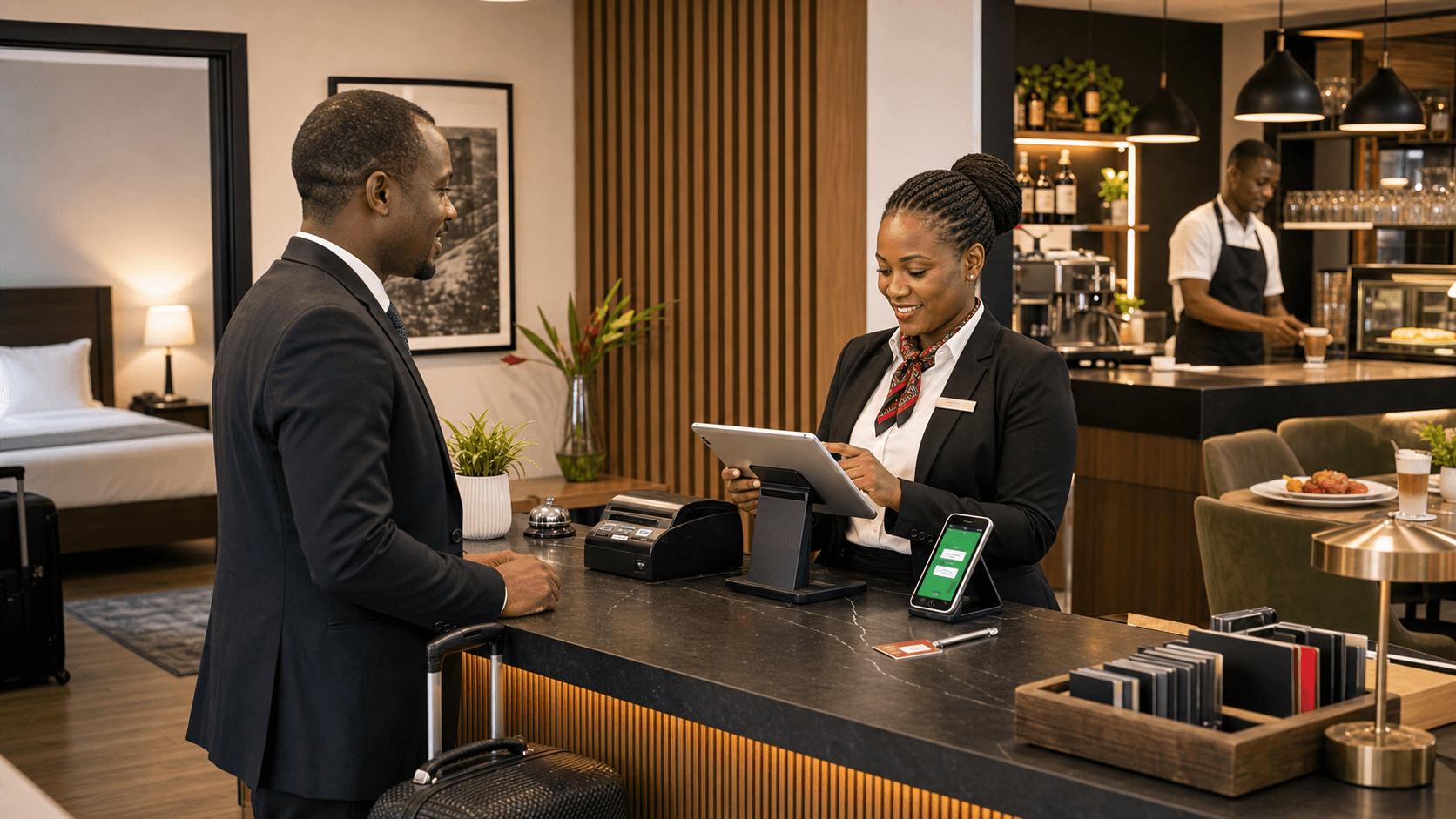
A hotel in Kenya is the most operationally complex business in hospitality — at minimum it runs rooms, restaurant, bar, and front desk; commonly it also runs conference rooms, a spa, a gym, laundry, transport and a gift shop, each with its own pricing, stock and staff. The Property Management System (PMS) is the binder that lets a single guest charge a meal, a drink, a massage and a phone call to the same folio, paid at check-out as one bill. Without it, you have five separate cash flows that never reconcile and a guest standing at reception arguing about what they owe.
This guide is for hotels across Kenya — the boutique hotel in Karen, the mid-market business hotel in Nairobi CBD, the safari lodges in Maasai Mara, Tsavo and Amboseli, the coastal resorts in Diani and Watamu, and the small upcountry hotels in every county town.
Rooms: The Rate Card Stack
A hotel does not sell "a room" at one price. The same room sells at multiple rates depending on who is buying and when:
- Walk-in / rack rate — the published full price. Highest margin, lowest volume.
- Corporate rate — negotiated with companies that send regular guests. 15–25% off rack.
- OTA rate — what Booking.com, Expedia, Jumia Travel sells. Net rate after their commission (15–22%).
- Conference / group rate — bulk discount for a block of rooms tied to a conference or wedding.
- Weekend rate — for leisure-driven hotels, weekends might price higher; for business hotels, weekends discount.
- Loyalty / repeat-guest rate — small loyalty discount that earns repeat business.
What the PMS Has to Track
- Room inventory by type — single, double, twin, executive, suite.
- Rate codes per room type per channel.
- Availability calendar — which rooms are occupied, blocked, in maintenance.
- Check-in and check-out times — for housekeeping rotation.
- Forecasted occupancy — daily, weekly, monthly.
The Folio: One Guest, Many Charges
The folio is the heart of hotel operations. When a guest checks in, a folio opens with their room rate accruing daily. Throughout their stay, every other charge flows to it:
- Restaurant bill — waiter says "charge to room 247." The bill goes to the folio.
- Bar drinks — same.
- Spa treatment, laundry, phone, mini-bar — all to the folio.
- Meeting room hire, conference catering, transport — to the folio.
At check-out, the front desk prints the consolidated folio bill, the guest pays, and the folio closes. Without this integration, the guest pays the restaurant separately, the bar separately, the spa separately — and accidentally walks out without paying for the mini-bar.
The PMS-POS Integration That Matters
Hotel POS systems for the restaurant, bar and spa need to talk to the PMS. When the waiter rings up a bill and selects "charge to room 247," the PMS validates the room is occupied and the guest hasn't checked out, and posts the charge. No room number means no room charge — the guest pays at the restaurant.
OTA Bookings: The Online Travel Agency Channel
Booking.com, Expedia, Agoda, Jumia Travel and Hotels.com collectively account for 30–60% of bookings at most Kenyan urban and tourism hotels. Managing OTAs:
- Channel manager integration — software that syncs inventory and rates between your PMS and every OTA. When a booking comes in on Booking.com, the room is automatically blocked on your other OTAs and walk-in inventory.
- Net rate vs commission — the OTA shows the guest a "headline" rate and charges you a commission (15–22%). Your PMS records the net rate as revenue.
- Cancellation policies — each OTA has its own; the PMS handles the no-show charges per the booking T&Cs.
- Reviews and ratings — the OTA ecosystem runs on reviews; consistent service across departments shows up in your scores.
Tourism Levy, Catering Levy and VAT
Hotels carry an unusually layered tax stack:
- Tourism Levy at 2% — charged on the accommodation portion of the bill, payable monthly to the Tourism Fund.
- Catering Levy at 2% — on food and drink served. Also goes to the Tourism Fund.
- VAT at 16% — on accommodation, F&B, conference room hire, and most services.
- KRA eTIMS — every receipt must carry a control number.
A typical room-night invoice line:
- Room rate (rack): KES 12,000.
- Tourism Levy (2%): KES 240.
- VAT (16% on room + levy): KES 1,958.
- Total room night: KES 14,198.
Restaurant and bar use the Catering Levy structure (see the restaurant guide). The PMS rolls everything into the folio with correct VAT and levy split per revenue centre.
Housekeeping and the Room Status Cycle
The room moves through statuses through the day:
- Occupied dirty — guest has checked out but the room isn't yet cleaned.
- Occupied clean — guest still in residence, room serviced.
- Vacant clean ready — room is cleaned and ready for arrival.
- Vacant dirty — between cleanings.
- Out of service — maintenance issue.
Housekeeping updates the status via tablet or paper sheet collected at the housekeeping office. The PMS shows the front desk in real-time which rooms are ready for new guests, which need cleaning urgently, which are blocked for maintenance.
Group Bookings and Corporate Accounts
Groups (weddings, conferences, school trips, NGO retreats) book multiple rooms with one invoice. The discipline:
- Group block — N rooms held under one booking name and contract.
- Rooming list — the customer provides the actual guest names closer to arrival.
- Master folio — accommodation and bulk services (meeting room hire, group catering) on the master.
- Individual folios — bar drinks, spa, individual extras — typically paid by the guest at check-out, not by the corporate account.
- Deposit and balance schedule — 30% at booking, 70% before arrival is common.
- Credit terms for known corporates — invoiced after the event, paid 30 days net.
F&B as a Standalone Revenue Centre
The hotel restaurant and bar generate 20–45% of total hotel revenue. They serve in-house guests (charged to room) and walk-in customers (paid directly). The POS workflow:
- Walk-in guests pay at the till like any restaurant.
- Hotel guests charge to room — the POS validates the room number with the PMS.
- End-of-shift F&B revenue is automatically split between "paid direct" and "posted to rooms."
- The conference and event catering bills go to the master folio.
FAQ
Do I need a Property Management System or can I use a regular POS?
For 4 rooms or fewer, you can run on a spreadsheet plus a POS for F&B. For 5+ rooms, a proper PMS pays for itself in reduced check-in time, OTA channel management and folio integration. Above 20 rooms, it is non-negotiable.
How do I integrate with Booking.com and other OTAs?
Through a channel manager — software that connects to your PMS and pushes inventory and rates to every OTA simultaneously. SiteMinder, RateGain, eZee and Cloudbeds are common in Kenya. Direct OTA-by-OTA management is possible but error-prone above 10 rooms.
What is the tourism levy and how often do I pay?
2% on accommodation revenue, paid monthly to the Tourism Fund through KRA's iTax. The Catering Levy (also 2%) goes to the same fund and is computed on F&B revenue.
How do I prevent guests from walking out without paying mini-bar charges?
Daily mini-bar audit by housekeeping with charges posted to the folio immediately. At check-out, the front desk confirms the room is clear of unposted charges before releasing the guest. Pre-authorisation on credit card or M-Pesa hold reduces the walkout risk.
Do hotel staff have to be food-handler certified?
Any staff handling food (kitchen, restaurant, bar, room service) must hold a current food handlers' certificate from the local public health office. Annual renewal. Inspectors check this.
The Bottom Line
A hotel is a multi-revenue operation that only works when every revenue centre — rooms, restaurant, bar, conference, spa — talks to a single folio per guest. A PMS that integrates with OTA channels, restaurant and bar POS systems, housekeeping status, and your VAT and levy reporting turns the complexity into manageable daily operations. Without it, hotels lose money in the gaps between departments and never quite know which channel is profitable.
Ready to try DukaSale?
Free POS app for Kenyan dukas. Track sales, inventory, M-Pesa payments, and customer credit — all offline.
Download Free