Running a Barbershop or Salon in Kenya: Appointments, Walk-ins, Staff Commission and Retail
How to run a profitable barbershop or salon in Kenya — managing appointments and walk-ins, staff commission structures, service menu pricing, the retail add-on revenue, and the POS workflow built for service businesses.
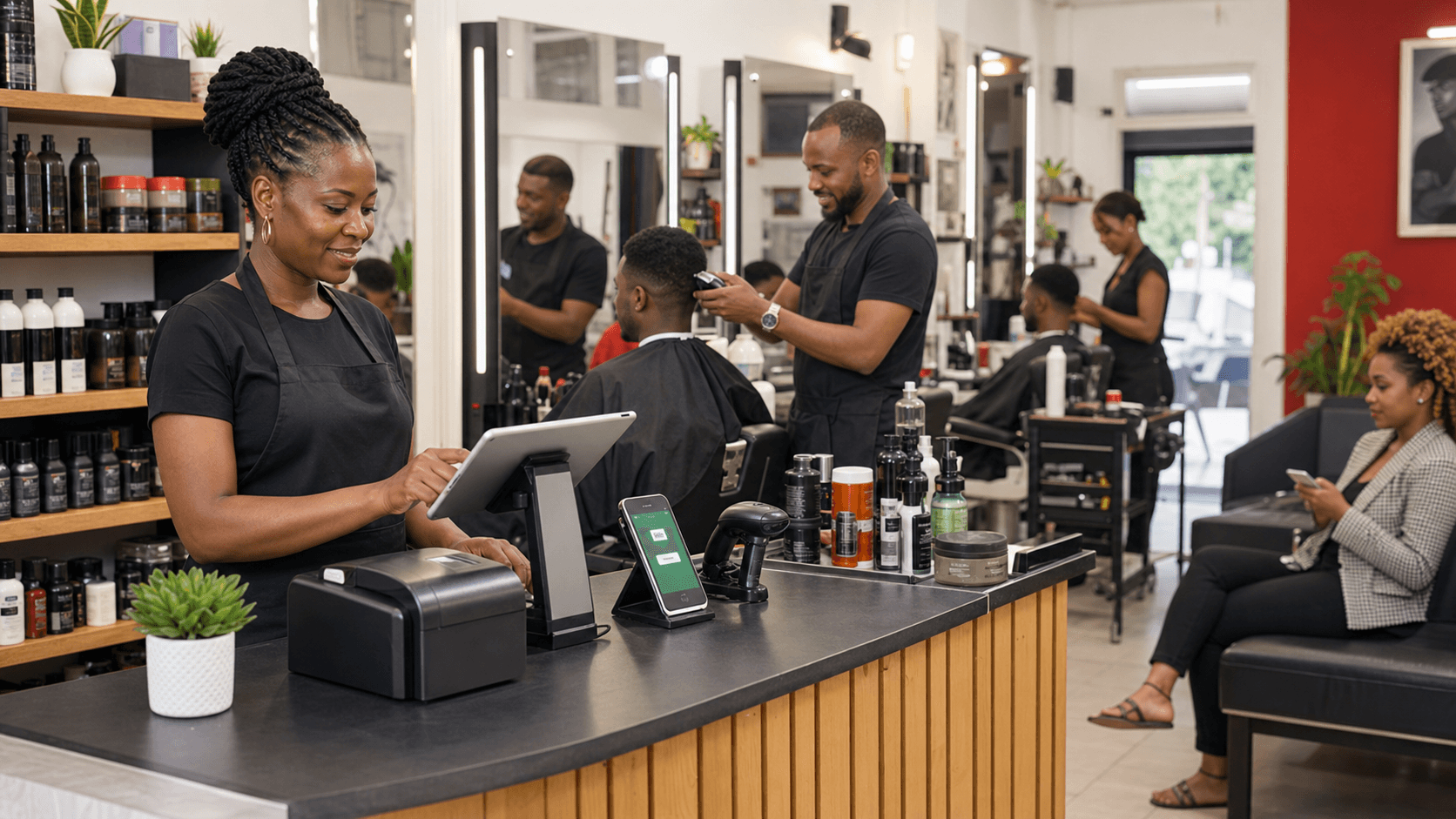
A barbershop or salon in Kenya does not sell products — it sells chair time, and chair time is the most perishable inventory in retail. An empty chair at 11am on Tuesday is revenue you can never get back. The shops that grow turn three things into a system: a clean appointment book that balances bookings with walk-ins, a staff commission structure that motivates without bleeding margin, and a retail add-on shelf that turns every customer into two transactions instead of one.
This guide is for barbershops and salons across Kenya — the corner-shop fade barbers, the high-end braiding lounges in Westlands and Karen, the unisex salons in every neighbourhood, and the spa-style premises that mix beauty services with retail. The operational realities are similar; only the price points and the customer mix change.
Appointments vs Walk-ins: The Booking Discipline
The first business decision every salon owner makes — implicitly or explicitly — is whether to run on appointments, walk-ins, or both. Each model has trade-offs.
- Walk-in only — simple, no missed appointments, but you face dead time when no one walks in and queues when everyone arrives at once. Most barbershops default here.
- Appointment only — predictable, no queues, but customers must plan ahead. Common for premium salons, less common in mass-market Kenya.
- Mixed — appointments take precedence; walk-ins fill the gaps. This is the practical model for most growing salons.
The Booking Slot Reality
Every service has a realistic duration. A standard haircut is 30–40 minutes. A retouch is 60–90 minutes. A full braiding job is 3–5 hours. A relaxer treatment is 60 minutes. A pedicure is 45 minutes. Your POS appointment book should hold:
- Service name with its expected duration.
- Stylist assigned (some customers only book with a specific person).
- Customer name and phone.
- Status: scheduled, in chair, completed, no-show.
The duration matters because over-booking a stylist (three 60-minute services in a 90-minute window) is how appointment-led salons lose reputation. The POS should warn when a slot is double-booked.
Handling No-Shows
No-shows are the killer of appointment-only salons. The defences:
- WhatsApp confirmation 24 hours before — "Hi Mary, confirming your braids appointment tomorrow at 10am with Aisha. Reply Y to confirm."
- Track no-show rate per customer. A customer with three no-shows in six months stops getting prime slots — they fill from the walk-in queue or pay a deposit to book.
- Deposit for long services — a 4-hour braiding job tying up a stylist for half a day deserves a KES 500–1,000 non-refundable deposit at booking. The POS records it; it becomes a discount on the final bill.
The Service Menu and Pricing
A clean, printed (or displayed on a screen) service menu prevents 80% of pricing arguments. Customers want to know what they will pay before they sit in the chair.
A typical Kenyan unisex salon menu:
- Hair services — wash and blow (KES 500–1,500), retouch (KES 1,000–2,500), braiding (KES 800–6,000 depending on style), weaves, dreadlocks, treatments.
- Barbering — basic haircut (KES 200–600), fade or design (KES 400–1,000), beard trim (KES 200–400), hot towel shave (KES 500–1,000).
- Nails — manicure (KES 500–800), pedicure (KES 800–1,500), gel polish (KES 1,200–2,500), acrylic extensions (KES 2,500–5,000).
- Skin — basic facial (KES 1,500–3,000), threading (KES 300–600), waxing.
- Add-ons — eyebrow shaping, henna, scalp treatment.
Each entry in the POS holds the price, the service duration, and ideally which stylist categories can perform it (so a junior is not booked for an advanced colour service they cannot do).
Staff Commission: The Motivation Lever
Most Kenyan salons pay staff a base salary plus commission on services they personally perform. The structure varies, but a common arrangement:
- Base salary — KES 8,000–18,000 monthly for assistants, KES 15,000–35,000 for experienced stylists.
- Commission — 10–30% of service revenue. The split skews higher (25–30%) when the stylist has their own clientele, lower (10–15%) for general-floor stylists.
- Retail commission — 5–10% on product sales they convert. This is the lever that turns stylists into salespeople.
- Tips — generally kept by the stylist; tracked in the POS as informational but not part of revenue.
Why the POS Has to Track Per-Stylist Sales
Commission is fair only if every service is correctly attributed to the stylist who performed it. The POS records each service against the chair/stylist; at month end, it generates a commission report:
- Services performed × the commission rate.
- Products sold (linked to the stylist who recommended them).
- Total commission owed for the period.
Without this, commission becomes an argument every payday. With it, the stylist trusts the number because they can see their own work history in the system.
Retail: The Other 30% of Revenue
Pure-service salons make 70–85% of revenue from chair time. The salons that hit 100% growth a year are the ones that get the retail mix right. A relaxer treatment is KES 2,000; a take-home relaxer maintenance kit is KES 1,800. Sell one of those to every relaxer customer and you have doubled the average ticket.
The Retail Cross-Sell Discipline
- Stock what you use. Customers want the products you applied to their hair. Don't sell a different brand from what you used in the chair.
- Educate, don't pitch. "I noticed your scalp is dry — this treatment oil would help you maintain the look at home" lands better than "do you want to buy something."
- Display at the till, not on a back shelf. The customer makes the decision in the 60 seconds while paying.
- Give the stylist commission. If they have skin in the game, they recommend.
Track the retail attach rate in the POS — what percentage of customers leave with a product. Aim for 20–30%. Top-performing salons hit 40%+.
The Loyalty Program That Actually Works
Salons benefit more from loyalty programs than most retail because the visit cadence is predictable — every 4–6 weeks for haircuts, every 6–8 weeks for hair colour, every 2–3 weeks for nails. The structure that works in Kenya:
- Loyalty card or POS-tracked profile — every visit logs a stamp.
- Tenth visit free (or 50% off) — simple to understand, motivating.
- Birthday discount — automatic 20% off the service of choice during birthday month.
- Referral credit — KES 500 off when you refer a new customer who completes a service.
The POS customer profile tracks visit count and last-visit date automatically; the loyalty rewards apply at checkout without the customer needing to bring a punched card.
FAQ
Do I need a separate POS for service appointments and product sales?
No — they should be in the same system. The cashier rings up the service first, the retail add-on second, and the customer pays a single total. Separate systems mean reconciliation pain and lost retail attach.
How do I handle two stylists working on the same customer?
Split the service. A braiding job where one stylist parts and another braids should be split 50/50 in commission. The POS lets you assign multiple stylists to a single service line.
Should I take card or just M-Pesa?
For mid-market and premium salons, take both. The M-Pesa Buy Goods till handles 90% of payments; a card terminal catches the higher-ticket customers who prefer card and avoids the per-transaction M-Pesa fee on big jobs.
What licences does a salon need in Kenya?
A single business permit from your county, a KRA PIN, and the Ministry of Health's salon health certificate (renewable annually). Health inspectors check water, hygiene, and proper disposal of disposables. Stylists ideally hold beauty trade certificates from a recognised college.
How many customers should a stylist see in a day?
A barber can do 12–18 standard cuts in an 8-hour day. A senior salon stylist on full-service days does 6–10 customers (longer services). Track the actual number per stylist in your POS — productivity reports tell you who is busy and who has gaps to fill.
The Bottom Line
A salon's growth is not driven by haircuts; it is driven by chair utilisation, commission alignment and retail attach. A POS that tracks appointments, attributes every service to a stylist, calculates commission automatically, and prompts retail add-ons at the till is the operational backbone of a salon that grows from one chair to four — and from one location to a small chain.
Ready to try DukaSale?
Free POS app for Kenyan dukas. Track sales, inventory, M-Pesa payments, and customer credit — all offline.
Download Free