Running a Bar or Pub in Kenya: Pour Accuracy, Stock Shrinkage, Tabs and the Licence Stack
How to run a profitable bar or pub in Kenya — pour accuracy and shot tracking, daily bottle-count stock control, customer tabs, the county liquor licence stack, music licensing, happy hour pricing, and the POS that ties it together.
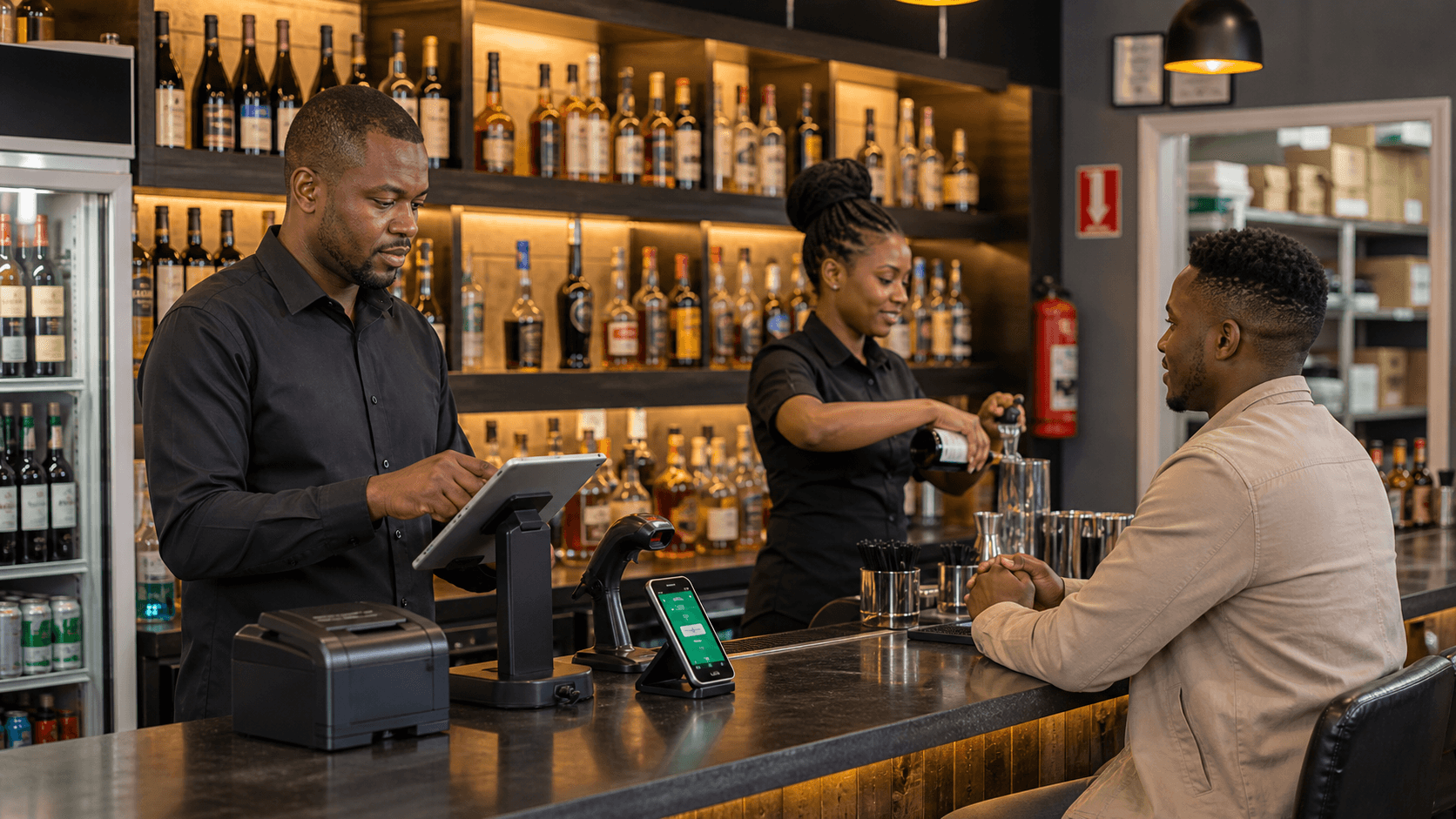
A bar in Kenya is a regulated, high-shrinkage, low-margin-on-the-bottle business where every short pour costs you KES 30 and every long pour costs you a customer. Half the bottles on the back wall are excisable, the till sees more cash than M-Pesa, and the licence stack from the county liquor board, the Ministry of Interior, KRA and the music collectors can shut the doors faster than any customer complaint. The bars that grow are the ones that pour with jiggers, count bottles daily, run customer tabs cleanly, and treat compliance as routine rather than panic.
This guide is for bars, pubs and sports bars across Kenya — the high-traffic spots in Westlands and Kilimani, the neighbourhood pubs, the sports bars showing English Premier League on Saturday afternoons, and the upcountry pubs in every market town.
The Licence Stack
Selling alcohol on-premises in Kenya requires multiple licences. Operating without any one of them can close the doors:
- County liquor licence — issued by the county liquor licensing board. Nairobi's NCCG Liquor Licensing Board is the most regulated; other counties have equivalent bodies. Fees vary by class (bar, restaurant-attached, club). Annual renewal.
- Single business permit — county trading permit.
- KRA PIN and VAT registration — alcohol businesses cross the VAT threshold quickly.
- Music licences — MCSK (Music Copyright Society of Kenya), PRiSK (Performers Rights Society) and KAMP (Kenya Association of Music Producers). If you play recorded or live music, you owe licence fees. The amount depends on premises size and music type.
- Public health certificate — kitchen, glassware washing, food handlers if serving food.
- Fire safety inspection — annual.
Display the licences where the inspector can see them. A POS configured with your business details prints them on every receipt — KRA PIN, licence number, premises address — which is what the regulator checks.
Pour Accuracy: Where the Margin Actually Lives
A bottle of standard Kenyan spirit holds 750ml. At a 25ml jigger pour, that is 30 shots per bottle. At a 30ml pour (looser hand), it is 25 shots. At a 35ml pour ("generous"), it is 21 shots.
The math:
- Bottle wholesale cost: KES 1,400.
- Shot retail price: KES 250.
- Expected revenue at 25ml pour (30 shots): KES 7,500. Margin: KES 6,100.
- Actual revenue at 35ml pour (21 shots): KES 5,250. Margin: KES 3,850.
- Loss to over-pouring: KES 2,250 per bottle — about 37% of expected margin.
How to Enforce the Pour
- Use jiggers, not free pour. Every spirit shot goes through a 25ml or 30ml measure. The customer sees it. The bartender cannot improvise.
- Use measured pourers for high-volume spirits. Speed-pourers calibrated to 25ml or 30ml are an inexpensive investment with high ROI.
- Train and audit. Spot-check bartenders during service. A consistent over-pourer either gets retrained or gets moved away from spirits.
- Track bottle counts daily. See below.
The Daily Bottle Count
The single most powerful shrinkage control in a bar is the closing bottle count. Every closing shift:
- Count every spirit bottle on the back wall — full, partial (estimate to nearest 10%), and empty.
- Enter the counts into the POS or paper sheet.
- Compare to the morning count plus deliveries minus sales-by-shot.
- Investigate any discrepancy beyond 1–2 shots per bottle (small variance is normal from spillage and "the angel's share" of evaporation).
A bar that does this catches theft on day one. A bar that does not do this loses 5–10% of revenue to "small leaks" — bartenders pouring free drinks for friends, comping their own drinks, or quietly bottle-swapping with cheaper stock.
EGMS Stamps: Same Story as Off-Licence
Every excisable bottle sold in Kenya must carry an Excise Goods Management System (EGMS) digital stamp. For an on-premise bar:
- Receive only stamped stock from your distributor. Bottle without a stamp goes back.
- Spot-check stamps at delivery — scan a few to verify the codes resolve.
- Empties — KRA can audit the empties bin too. Unstamped empties suggest you sold unstamped stock.
Customer Tabs
Bars run on tabs. A customer walks in, hands the bartender a card or pays an opening deposit, and orders drinks throughout the night. The bartender adds each drink to the tab. The customer pays at the end, or topped-up midway.
The Tab Discipline
- Tab opens with a customer card or ID. No anonymous open tabs — too easy for the customer to walk out without paying.
- Tab attached to a specific bartender — the person serving owns the tab until handoff or close.
- Every drink immediately added to the tab via the POS. No "I'll ring it up later" — that is where shrinkage hides.
- Closing the tab — show the customer the itemised bill, take payment (cash, M-Pesa STK push, card), print receipt.
- Walked tabs — customer leaves without paying. The bartender's PIN is recorded against the lost tab; persistent walked-tab issues with the same staff member are an investigation trigger.
Happy Hour and Promotion Pricing
Most bars run happy hour or promotional pricing — 50% off cocktails on Tuesday, KES 100 beer between 5pm and 7pm, "Pitcher Wednesday."
What the POS Should Handle
- Time-based pricing — the same drink rings up at KES 250 between 5pm and 7pm and KES 350 after 7pm. The POS handles the switch automatically, not by the bartender's memory.
- Promotion-specific SKUs — "Happy Hour Margarita" might use a smaller spirit pour than the regular menu version; track it as a separate item so margins stay clean.
- Voucher and group promotions — discount codes redeemable at the till; the POS records them as discounts against revenue, not invisible give-aways.
Operating Hours and Late-Night Compliance
County regulations restrict bar operating hours. In Nairobi:
- Standard bar licence — 5pm to 11pm weekdays, broader hours weekends.
- Extended hours licence — for clubs and entertainment premises with appropriate sound, parking and waste compliance. More expensive, more inspections.
- Sunday and public holiday restrictions apply in some counties and on certain dates.
Pour past closing time and you are operating without a licence — even by a few minutes. The POS can be configured to flag or refuse alcohol sales outside licensed hours, with a manager override that records every after-hours transaction.
Shrinkage Beyond the Pour
- Breakage — glassware, bottles dropped during service. Record it; budget 1–2% of revenue.
- Spillage — measured pours reduce but do not eliminate. Budget 1–2%.
- Staff drinks — track them as comps. If staff drink quietly off-the-books, they are theft.
- Manager comps — sometimes appropriate (a complaining customer, a regular's birthday). PIN-gated, recorded, reviewed weekly.
- Free drinks for friends — the biggest single shrinkage vector. The defence is daily bottle counts plus per-bartender sales analysis.
FAQ
How do I price drinks in a Kenyan bar?
Standard formula: spirits at 5–7x the wholesale-per-shot cost (so KES 47/shot wholesale becomes KES 250–350 retail). Beers at 2.5–3x wholesale (KES 80 wholesale becomes KES 200–250). Cocktails at 4–5x ingredient cost, factoring in labour. Wines and premium spirits sit at the lower multiple (3–4x) because the bottle ticket is already high.
Should bartenders carry the same PIN as waiters?
No — bartenders, waiters and managers all have their own PINs. The POS audit log shows who poured what, who voided what, and who comped what. Shared PINs make shrinkage untraceable.
What is the minimum age for buying alcohol in a Kenyan bar?
18 years. ID anyone who looks under 25. A confirmed sale to a minor is grounds for licence revocation.
How often should I do a full bar stock-take?
Daily for spirits and key SKUs (the closing bottle count). Weekly for the full bar including beers, wines and mixers. Monthly for a comprehensive stock take with cost reconciliation.
What music licences must a bar pay in Kenya?
MCSK, PRiSK and KAMP each collect for different rights — composers, performers, producers. The annual fees depend on premises size and music type. Operating without paying is a common violation; pay it.
The Bottom Line
A bar's margin is a function of how disciplined the pour is, how clean the licence stack is, how accurate the daily bottle count is, and how well the POS handles tabs, happy hour pricing and per-bartender accountability. The bars that grow into two and three locations are the ones that ran the first location like an operation, not like a hangout.
Ready to try DukaSale?
Free POS app for Kenyan dukas. Track sales, inventory, M-Pesa payments, and customer credit — all offline.
Download Free