Running a Bakery in Kenya: Production Planning, Waste Control, Wholesale Orders and Made-to-Order Cakes
How to run a profitable bakery in Kenya — daily production planning by demand pattern, perishables and waste discipline, wholesale customer accounts (schools, hotels, supermarkets), made-to-order cake job sheets, and the POS workflow that holds it together.
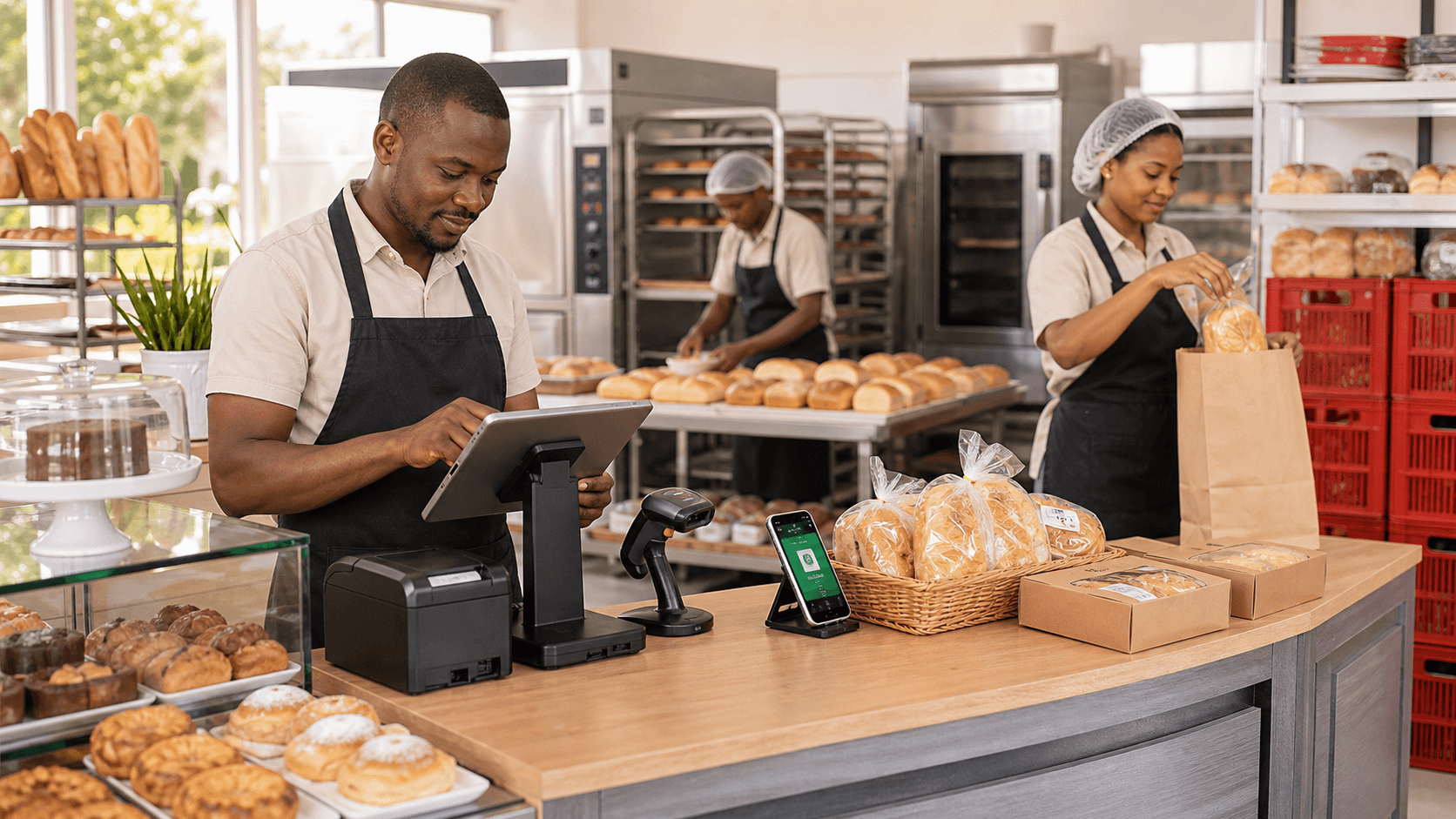
A bakery in Kenya is three businesses sharing one oven: a counter retail shop selling bread, cakes and pastries to walk-ins, a wholesale operation supplying schools, hotels and supermarkets on fixed orders, and a made-to-order cake business taking custom briefs for weddings, birthdays and corporate events. Each channel has its own production planning, margin and discipline. The bakeries that grow are the ones that run all three from a single POS view — not three notebooks and a WhatsApp group of cake requests.
This guide is for bakeries across Kenya — the neighbourhood bakery on a residential street, the artisan-bread spot in Lavington, the wholesale supplier in Industrial Area, the wedding-cake studio in Karen, and every small-town bakery that sells bread by morning and cake by afternoon.
Production Planning: Bake to Demand, Not to Hope
The hardest decision in a bakery happens at 4am: how much of each product to bake for the day. Bake too much and end-of-day waste eats your margin. Bake too little and you lose afternoon customers to the empty shelf.
The Demand Pattern
After a few weeks of selling, your POS sales report shows the demand curve by day of the week. A typical Nairobi neighbourhood bakery:
- Monday — moderate sales, restock weekend gap.
- Tuesday–Thursday — steady office and home buyers.
- Friday — strong, pre-weekend stock-up.
- Saturday — peak (especially morning).
- Sunday — half-day pattern; church-bound buyers and lunch baking.
Within each day, demand peaks at breakfast (6–9am) and again late afternoon (3–6pm). Plan your production accordingly:
- Bread — bake 80% of the day's expected volume by 6am; bake the remaining 20% mid-morning for late buyers.
- Cakes and pastries — bake to fill the display by opening; restock the high-turnover items at lunchtime.
- Specials — limited quantity, displayed prominently, signal to customers that you sell out.
What the POS Should Tell You
- Average daily sales by product, by day of week.
- Sell-through rate — what percentage of baked product was sold by closing.
- End-of-day waste — what was thrown out or sold at clearance pricing.
- Margin per product after waste — the true profitability.
Waste Discipline: The Real Margin Killer
Bakery products are mostly 24–72 hour perishables. Bread loses freshness overnight. Cream cakes are 48-hour products. Cookies hold longer. Industry-typical bakery waste is 8–15% of production. The bakeries that hit 4–8% waste are meaningfully more profitable.
The Waste-Control Stack
- Bake to forecast, not to hope. Production planning starts with the POS demand curve.
- End-of-day discount. Bread and pastries at 50% off in the last hour. Moves 60–70% of leftovers.
- Staff discount on remainders. What does not sell at closing goes to staff at cost — better than the bin.
- Donations to schools or charities. Common for bakeries with religious or community ties; some claim CSR value.
- Composting. Last resort for genuinely unsellable product. Reduces dump-site costs and ESG criticism.
Track the waste in the POS — every wasted item logged with a reason code (expired, damaged, discounted-not-sold, given-to-staff). The waste report tells you which products are over-baked and which need more capacity.
Wholesale Accounts: The Stable Revenue Anchor
Counter sales are unpredictable. Wholesale customers — schools, hotels, restaurants, supermarkets, hospitals — order in standing quantities on regular cycles. A school buying 200 bread loaves three times a week, every term, is KES 100,000+ monthly revenue at predictable margin and at scheduled delivery times.
The Wholesale Customer Profile
- Customer name and contact, with multiple authorised orderers (the school's catering manager, the hotel's chef).
- Standing order — "Mon/Wed/Fri: 200 white loaves, 80 brown loaves, 20 dozen rolls."
- Delivery address and time window.
- Negotiated wholesale price tier (typically 15–25% below retail).
- Credit terms — 14 days, 30 days, or COD depending on history.
- Aged-receivables tracking — who is paying on time, who is sliding into collection territory.
How the POS Should Handle It
- Wholesale customers ring up at their tier pricing automatically — no manual discount math.
- A standing order can be auto-generated each delivery day; the POS prepares the picking slip.
- Delivery confirmation captured (driver signature, photo of delivered goods, customer sign-off).
- Invoice issued, payment terms tracked, statement of account generated monthly.
Made-to-Order Cakes: The Job Sheet Side
Wedding cakes, birthday cakes, corporate cakes — these are high-margin, time-bounded, custom work. The workflow looks more like a tailor shop than a retail bakery.
The Cake Order Workflow
- Quote / consultation — customer describes occasion, flavour, size, design. The bakery shows samples, agrees price.
- Deposit taken — typically 50% to start, 50% at collection. For weddings often 30% at booking, 70% one week before.
- Order on the job sheet — date needed, flavour, tier sizes, design notes, allergies, dietary requirements, contact phone, delivery or pickup.
- Production scheduled backwards from the deadline — bake day, decoration day, delivery day.
- Quality check before handover — photograph the finished cake before it leaves the shop. Protects against later disputes.
- Delivery or collection — customer signs the job sheet; balance paid.
Pricing Custom Cakes
- Base price by size/tier — KES 3,000 for a single 8-inch round, KES 12,000 for a three-tier wedding cake.
- Add-ons — fondant work, sugar flowers, themed decoration, additional flavours.
- Delivery fee — based on distance and complexity (a wedding cake is delivered, assembled on-site, photographed).
- Margin: typically 60–75% on materials, less when complex decoration consumes hours.
Raw Material Inventory
A bakery's recipe consumption is more predictable than its sales. A 1kg loaf of bread uses 600g flour, 10g yeast, 15g salt, 25g sugar, 15g shortening — every time. The POS should ideally support recipe-based inventory:
- Each product has a recipe (BoM) attached.
- When the product sells, the recipe ingredients are deducted from raw material stock automatically.
- Re-order points trigger before flour, yeast, sugar or eggs run out.
Without recipe-based deduction, you only know how many loaves you sold — not how much flour you have left until the storekeeper walks in and tells you. Recipe-level tracking is the difference between a 3am scramble and a planned reorder.
FAQ
What licences does a bakery need in Kenya?
Single business permit, KRA PIN, public health certificate (kitchen inspection), food handlers' certificates for every staff member, KEBS standardisation mark for packaged products if you sell pre-packaged bread or pastries.
How do I price bread and pastries?
Bread: 2–3x ingredient cost (covers labour, oven gas/electricity, rent). Pastries: 3–4x ingredient cost. Made-to-order cakes: 4–6x ingredient cost. Wholesale tiers run at 25–35% gross margin.
Can a phone POS handle a wholesale bakery?
For up to ~10 wholesale accounts and counter sales, yes. Beyond that, scale to a tablet or browser POS that supports proper customer tiers, recipe-based inventory, route delivery sheets and credit aged-receivables.
How do I handle a customer who picks up a wedding cake and complains afterward?
Photograph every cake before it leaves the shop — proof of finished quality. The job sheet captured customer-approved design at booking. If a dispute arises, the photo + signed job sheet + collection confirmation defends you.
What is a healthy daily waste rate?
Under 8% is good. Under 5% is excellent. Anything above 12% means you are over-baking — usually the most-baked SKU (white bread) is the offender. Adjust production downward and watch the figure improve.
The Bottom Line
A bakery's profitability is a battle between freshness and waste, between counter unpredictability and wholesale stability, between repeatable bread and bespoke cake. A POS that runs all three sides from one screen — production planning by demand, wholesale customer tiers, made-to-order job sheets, recipe-based raw material tracking — is the operational backbone of a bakery that scales from one shop to a brand with delivery vans and corporate accounts.
Ready to try DukaSale?
Free POS app for Kenyan dukas. Track sales, inventory, M-Pesa payments, and customer credit — all offline.
Download Free