Phone Repair Shop in Kenya: Job Sheets, Parts Inventory, IMEI Tracking and the Counterfeit Parts Problem
How to run a profitable phone repair shop in Kenya — managing job sheets and customer hand-overs, genuine vs aftermarket parts, IMEI tracking, repair warranties, and combining repair with used phone sales.
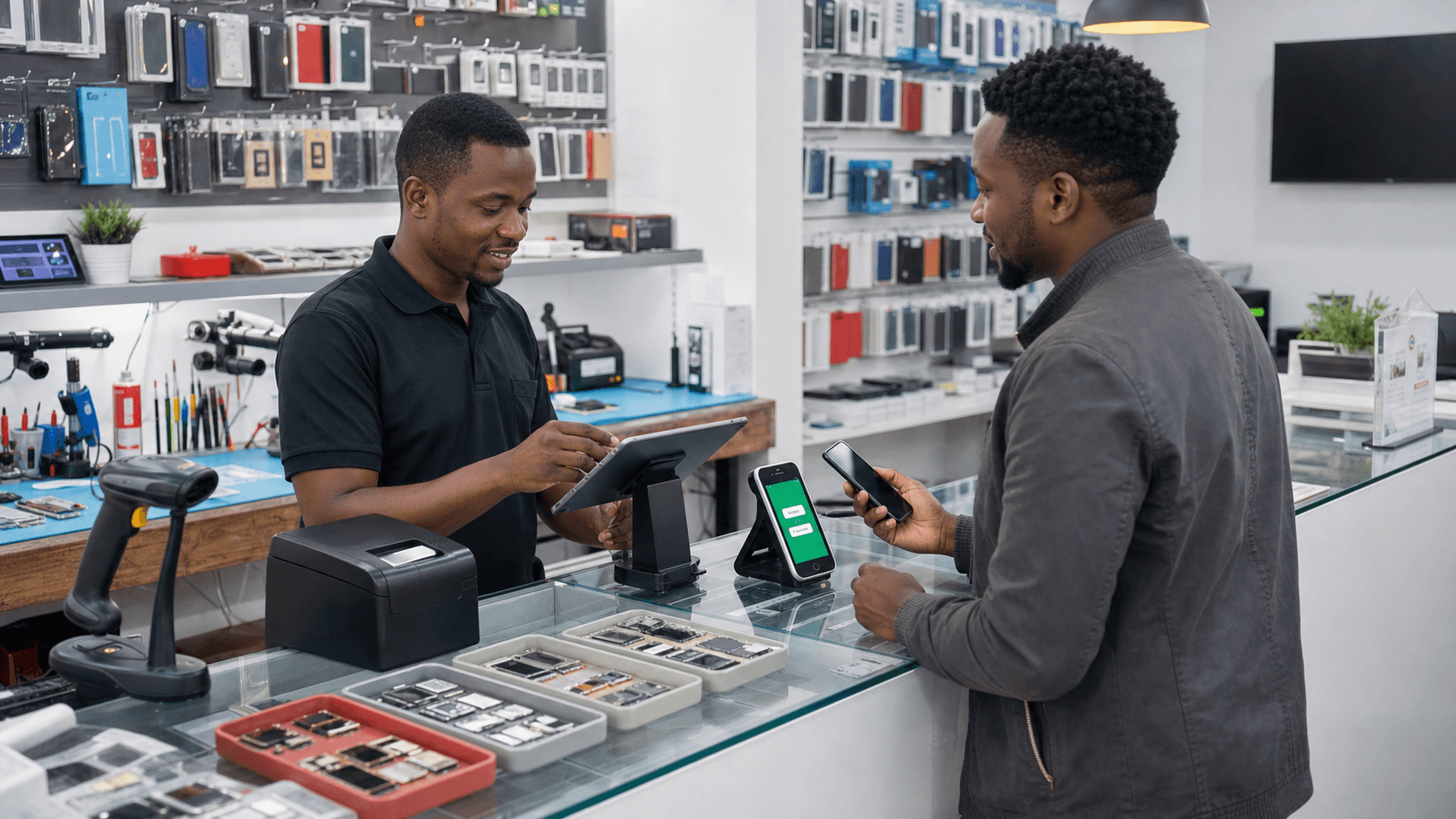
A phone repair shop in Kenya runs three businesses out of one counter: a repair service with job sheets and customer hand-overs, a parts inventory of screens, batteries, charge ports and tiny IC chips, and often a used-phone resale business on the side. Each business has its own margin profile and its own shrinkage risk. The shops that grow are the ones that treat repair as a tracked workflow — not a verbal agreement — and parts as a serial-numbered inventory, not a drawer of mystery boxes.
This guide is for phone repair shops across Kenya — the Luthuli Avenue specialists in Nairobi, the Moi Avenue Mombasa shops, the small-town repair counters tucked into electronics shops, and the increasingly common dedicated repair-and-trade-in storefronts in malls.
The Job Sheet Is the Whole Business
A repair shop without a job sheet system is a shop where customers and the shop owner argue about what was wrong, what was fixed, how much was promised, and what was lost. The job sheet is the contract.
What Every Job Sheet Must Capture
- Customer name and phone number.
- Device make, model and IMEI. Scan or type. IMEI is the unique fingerprint.
- Reported fault. The customer's description: "screen cracked," "won't charge," "no sound from speaker."
- Accessories received. Did they hand over the charger? The cable? The case? Every accessory is tracked.
- Visual condition. Existing scratches, dents, bezel wear. Photograph if possible.
- SIM and memory card status. SIM removed and given back, or kept inside.
- PIN / passcode. Asked only if needed for the repair; written on the job sheet temporarily.
- Estimated cost and timeline. Given verbally, written on the sheet, customer agrees.
- Deposit taken — see below.
- Job number / ticket number — printed on the customer's slip; same number on the device label.
The POS holds the job sheet digitally. The customer gets a printed slip or a WhatsApp message with the job number. They can call to ask "is my phone ready?" and the front desk pulls up the status in 10 seconds.
Deposits: When and How Much
Phone repair deposits are situational:
- Standard repairs (screen replacement, battery swap, charge port) under KES 4,000 — 50% deposit. Locks in the customer commitment and covers the parts.
- Diagnostic-only first — sometimes the customer wants you to "have a look" before quoting. Charge a non-refundable diagnostic fee (KES 200–500) that converts to credit against the repair if they go ahead.
- High-value repairs (motherboard work, water damage recovery) — 60–70% deposit, parts ordered against confirmed payment.
- Trade-in offers — separate from repair; the customer's old phone is valued and credited against a new or refurbished unit.
Without deposits, you order a screen for a customer who never comes back. You eat the parts cost. Three of those a month and a small shop is in trouble.
Parts: The Hidden Inventory Challenge
A serious phone repair shop holds dozens to hundreds of part SKUs — replacement screens (LCD, OLED, original vs aftermarket), batteries by model, charge port flex cables, speakers, microphones, back glass panels, camera modules, side buttons, SIM trays, and the tiny IC chips that drive everything. Each model has its own ecosystem.
The Counterfeit Parts Problem
Phone parts in Kenya come in three quality tiers:
- Original / OEM — sourced from the manufacturer or authorised refurbisher. Highest cost, longest life, best customer experience.
- Aftermarket (high quality) — third-party manufacturers making compatible parts to a high standard. Lower cost, slightly shorter life, generally fine for most repairs.
- Aftermarket (low quality / counterfeit) — cheap clones with poor colour reproduction, weak adhesives, short life. Common on Luthuli Avenue at "too good" prices. They fail within months and destroy your reputation.
The shop's parts policy must be explicit:
- What grade of parts does each repair use by default?
- What is the price difference between grades?
- The customer can choose to upgrade or downgrade, but the choice is recorded on the job sheet and on the receipt.
- The warranty differs by grade — original parts may carry 90-day warranty, aftermarket 30-day, low-grade aftermarket none.
IMEI Tracking and the Stolen-Phone Question
Every phone has an IMEI. When a customer drops off a device, the shop should record the IMEI. This protects the shop in two ways:
- Customer disputes — "this is not the phone I dropped off" is impossible when the IMEI on the job sheet matches the device.
- Stolen phone investigations — the Communications Authority and police can subpoena records. A shop that recorded the IMEI is cooperating; a shop with no record looks complicit.
For shops that also sell used phones, IMEI tracking is essential. Every used unit you buy should be IMEI-recorded, the seller's ID captured, and the IMEI checked against a stolen-phone database where available. Selling a stolen phone — even unknowingly — exposes the shop to legal liability.
Warranty on Repairs
A repair without a warranty is a repair the customer does not trust. A reasonable, fair warranty structure:
- Screen replacement (original) — 90 days against manufacturer defects.
- Screen replacement (aftermarket) — 30 days against manufacturer defects.
- Battery replacement — 90 days; battery must hold reasonable charge.
- Charge port / speaker / mic — 30 days.
- Motherboard work — 14 days, given the complexity.
- Always void on: physical damage after the repair, liquid damage, unauthorised disassembly.
The job sheet and receipt should print the warranty terms. When a customer returns within warranty, the POS pulls up the original job, the technician re-assesses, and the repair is redone or escalated.
The Trade-In and Used Phone Side
Many Kenyan repair shops also buy and sell used phones. The operational discipline:
- Buy-in inspection — IMEI check, condition grading, factory reset, screen and battery test, charging port test. Pay accordingly.
- Refurbish if needed — small repairs to bring a phone to sellable grade, cost recorded against that specific unit.
- Resale — IMEI captured at sale, customer name on the receipt, 30-day return policy for fault (not for change of mind), no warranty on battery or screen unless it was just replaced.
Customer Hand-Over: The Make-or-Break Moment
Every repair ends with a hand-over. The discipline that protects both shop and customer:
- Power on the device in front of the customer. Show that it boots, the screen is clean, the touch works, the cameras work, the speaker plays sound.
- Test the specific repaired function. Replaced the charge port? Plug in a cable and show it charges.
- Return all accessories. Charger, cable, case — match the job sheet's "received" list.
- Balance paid. If a deposit was taken, the balance is paid before the device leaves the counter.
- Receipt and warranty card. Printed, signed by the customer.
- Job marked completed in the POS, with technician initials.
FAQ
What is the typical margin on phone repairs?
Screen replacements: 35–55% gross margin on labour + parts. Battery replacements: 50–65%. Diagnostic and motherboard work: 60–80% (mostly labour). The blended margin for a busy repair shop sits at 45–55%.
How do I detect counterfeit phone parts?
Buy from a few trusted suppliers, not the cheapest one each time. Test a sample from every batch — light up the screen and check colour, install a battery and run a charge cycle, look for inconsistent printing on the part. Cheap parts have poor adhesives that fail within weeks.
Do I have to register every customer phone with the Communications Authority?
No — that is the customer's responsibility (KYC at the SIM card purchase). The shop's responsibility is to capture IMEI and customer details for any repaired or sold device, so that records exist if requested.
How do I handle a customer who claims I damaged their phone during repair?
The job sheet's "visual condition at intake" — ideally with a photograph — is your shield. If the device came in with a cracked back glass and the job sheet records it, the customer cannot claim it happened in your shop. Without that record, you lose the argument by default.
Can I run a phone repair shop on the same POS as a retail business?
Only if the POS supports job sheets with status (intake, diagnosed, in repair, awaiting parts, completed), per-device IMEI capture, deposit and balance tracking, and parts inventory at the SKU level. Pure-retail POS systems do not cover the service workflow.
The Bottom Line
A phone repair shop's reputation is built one repair at a time and lost just as fast. The shops that grow have a job sheet for every device, an IMEI on every job sheet, a tracked parts inventory by quality grade, a clear warranty policy, and a customer hand-over discipline that demonstrates the work. The POS is the system that holds all of this together — the binder, the till, the inventory book and the warranty database in a single screen.
Ready to try DukaSale?
Free POS app for Kenyan dukas. Track sales, inventory, M-Pesa payments, and customer credit — all offline.
Download Free