Electronics Shop POS in Kenya: IMEI Tracking, Warranties and the Counterfeit Problem
How to run an electronics shop in Kenya — serial number and IMEI tracking, warranty databases, KEBS-compliant sourcing, returns and DOAs, and the after-sales workflow that protects your reputation.
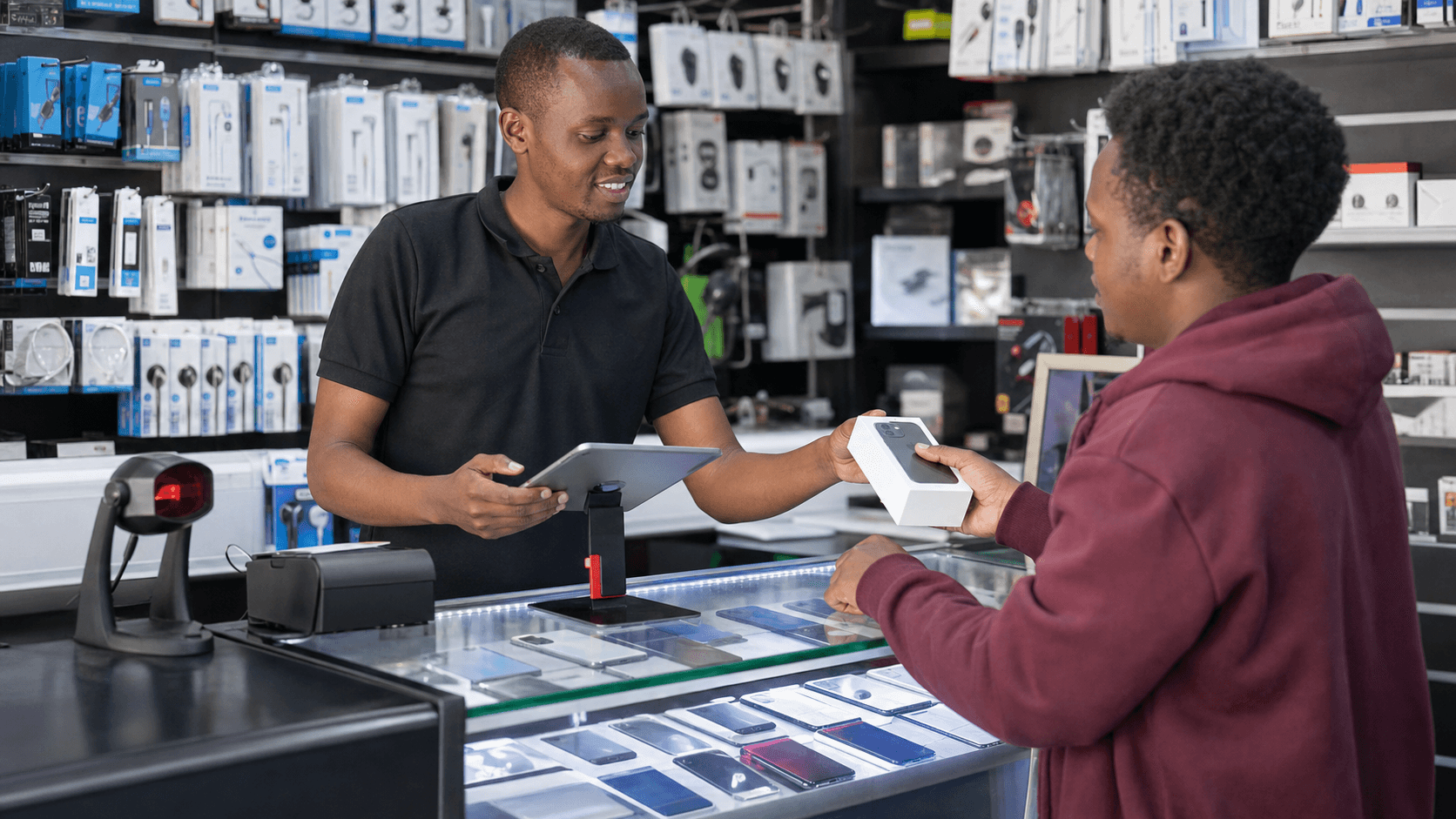
An electronics shop in Kenya is the opposite of a supermarket: low volume, high value, and one wrong sale can wipe out a week's profit. Sell a counterfeit phone, lose a warranty claim, miscount a single tablet during stock-take — and you have lost more than you would in a month of supermarket shrinkage. The POS that runs a good electronics shop is built around three things the trade cannot ignore: serial numbers, warranty records, and after-sales service.
This guide is for shops selling phones, TVs, laptops, audio gear, accessories and household electricals along Luthuli Avenue, in Garden City, on Moi Avenue Mombasa, or in any town where customers walk in knowing what they want and walk out expecting you to honour what you sold.
Why Serial Numbers Are the Whole Game
Every phone has an IMEI. Every TV, laptop, fridge and printer has a serial number. In a serious electronics shop, the serial is more important than the SKU. Two iPhones with the same SKU are not interchangeable — one might be a Kenyan official import with a 1-year local warranty, the other might be a grey-market unit with no Kenyan warranty support at all. The serial number tells you which is which.
What "Tracking Serials" Means at the Till
When you sell a phone or laptop, the cashier scans the SKU and then types or scans the IMEI/serial. The POS attaches that specific unit to that specific receipt and that specific customer. You should now be able to answer three questions at any time:
- Who bought serial number 357213450012345, and when?
- What is the warranty expiry date on that unit?
- Where did we buy it from, and at what cost?
If a customer walks in six months later with a faulty phone, you scan the IMEI, the POS pulls up the original sale, you check the warranty period, and you decide whether to repair, replace, or refer to the manufacturer. Without that record, you are arguing with the customer based on memory and a paper receipt they may or may not have kept.
Receive Serials at Purchase, Not at Sale
The discipline mistake most electronics shops make is to enter serial numbers only when something sells. By then, if a unit is missing from the box, you have lost the trail. The right flow is:
- Delivery arrives — open the cartons, list every IMEI/serial received against the purchase order.
- POS records each serial as in-stock, linked to the supplier and the landed cost.
- At sale, the POS marks that specific serial as sold.
- If a unit is returned, the same serial is marked as returned-to-stock or returned-to-supplier.
This way, if you ordered 20 Samsung A05s and the box only has 19, you find out on the loading bay, not three weeks later when you cannot find the 20th unit.
The Counterfeit Problem and KEBS
Kenya's electronics market has a long counterfeit and grey-market history. KEBS (the Kenya Bureau of Standards) operates the Pre-Export Verification of Conformity (PVoC) programme and the Standardisation Mark, which is meant to guarantee that imported electronics meet safety standards. In practice:
- Genuine, KEBS-cleared stock — sold through official distributors like Mi Kenya, Samsung KE, LG East Africa. Costs more, comes with proper local warranty and serial registration.
- Grey-market stock — same brand, same model, imported through unofficial channels. Cheaper at the cost line, but the warranty is your problem, not the manufacturer's.
- Counterfeits — outright fakes built to look like a brand. These are illegal to sell.
You can blend genuine and grey-market in a single shop legally, but you must disclose what you are selling. A customer who pays KES 35,000 thinking they got an official Samsung deserves to know that the warranty is your shop's promise, not Samsung Kenya's. Mark each SKU in your POS as "official" or "import" so the receipt tells the truth.
The Warranty Database
Every electronics shop in Kenya offers some warranty — typically 7 days for shop returns, 1 year for manufacturer faults, and the standard "no warranty on physical damage or liquid damage." The shops that protect their reputation make the warranty a record, not a promise.
What the Warranty Record Should Contain
- Serial / IMEI of the unit — the only unique identifier that matters.
- Customer name and phone number — so you can call them when a unit is ready after a repair.
- Sale date — start of warranty period.
- Warranty length — 30 days, 6 months, 1 year, 2 years. Different products, different terms.
- Coverage scope — what is covered (manufacturing defect, battery) and what is not (physical damage, water damage, theft).
- Supplier warranty backing — does the distributor reimburse you if you replace a unit? Capture the supplier's RMA process at purchase, not after a claim.
Returns, DOAs and the 7-Day Window
Dead-on-arrival units are routine in this trade. A customer buys a phone, gets home, opens it, the screen does not light up. You need a clear, fast policy:
- Inside 7 days, with original packaging, no physical damage — straight swap from your in-stock units. The DOA goes back to the distributor on the next RMA run.
- Inside 14 days, manufacturer fault, no physical damage — workshop assessment first, then repair, replace, or full refund.
- After 14 days but inside warranty — repair through the official service centre, customer pays for postage to the service centre if the unit is out-of-Nairobi.
The POS should print these terms on every receipt. The customer should know what they bought before they leave the shop.
The After-Sales Workflow
An electronics shop without an after-sales workflow loses customers to the first competitor who has one. The flow:
- Customer brings in faulty unit. Front desk records IMEI, complaint description, accessories returned (charger? cable? box?). Issues a job sheet number.
- Workshop assesses. Technician records findings against the job sheet — what is wrong, what it will cost to repair, how long it will take.
- Customer is called with the estimate. They approve, decline, or ask for a quote alternative.
- Repair happens or unit is escalated to the service centre. Status updates in the system.
- Unit is collected. Customer signs the job sheet, the POS records the collection, and any post-repair warranty is logged.
The POS should hold all of this — not a separate Excel sheet. The customer should be able to call and ask "is my phone ready?" and your front desk should answer in 10 seconds.
Cash, M-Pesa and the High-Value Sale
An electronics sale is rarely a small ticket. A laptop or a 55" TV is KES 80,000–250,000. Two payment realities that matter:
- M-Pesa Buy-Goods has a daily customer transaction limit — currently KES 500,000 per buyer per day. For higher-value sales, you need bank transfer (Pesalink to the shop account is the fastest), Lipa na M-Pesa till for amounts under the limit, or split payments across two days.
- Cash deposits over KES 1,000,000 trigger bank reporting. Once your shop scales, plan for transactions to land in the bank, not the safe.
A POS that handles split payment (KES 300,000 by Pesalink, KES 200,000 by M-Pesa, balance in cash) is the difference between closing a sale on the spot and asking a customer to come back tomorrow.
Inventory Valuation: Why Cost Tracking Matters Here More
In a duka, mis-pricing cooking oil by KES 5 is annoying. In an electronics shop, mis-pricing a phone by KES 1,500 is a real loss. The POS should track:
- Landed cost per unit — supplier price plus import duty plus VAT plus transport. Without landed cost, your "margin" report is fiction.
- Currency exposure — most electronics distributors price in USD and bill in shillings at the day's rate. A 5% shilling weakening between order and sale wipes out a phone's margin.
- Average cost or FIFO? — pick one and stick to it. For most independent shops, weighted average is simpler and good enough.
FAQ
Do I have to track IMEI for every phone I sell?
You do not have to by law — but you should, because Communications Authority can subpoena that record if a sold phone is later used in a crime. The IMEI also protects you from "this is not the phone I bought" disputes. Two minutes per sale, every sale.
What is the difference between official and grey-market electronics in Kenya?
Official imports come through authorised distributors, are KEBS-cleared, carry a local manufacturer warranty, and have official after-sales service. Grey-market units are the same brand and model but imported through unofficial channels; the warranty is your shop's promise, not the manufacturer's. Both can be legal — the issue is disclosure.
How do I handle a warranty claim if the customer lost the receipt?
If your POS attached the IMEI/serial to the customer at purchase, the receipt does not matter — you can pull the warranty record by serial number. This is the operational reason serial tracking pays for itself.
Should I sell phone accessories on the same till as phones?
Yes — but treat them as separate SKUs with separate margins. Accessories typically run at 40–60% margin, phones at 5–10%. Mixing them lets the system show you that accessories are pulling more profit than the headline phone sale.
What about VAT on electronics?
Electronics are standard-rated for VAT in Kenya at 16%. Once you cross the KES 5 million turnover threshold, you must register and charge VAT. Your POS should price either VAT-inclusive (the customer sees the all-in price) or VAT-exclusive (the customer sees the price plus VAT line) — pick the convention your customer base is used to.
The Bottom Line
An electronics shop lives or dies on traceability. Every unit you receive has a serial. Every unit you sell has a customer. Every fault that comes back has a job sheet. A POS that does not track serials, warranties and repair jobs is a cash register, not a business system. Spend the extra two minutes per sale to record the IMEI — that record is what saves you when a warranty dispute arrives six months later.
Ready to try DukaSale?
Free POS app for Kenyan dukas. Track sales, inventory, M-Pesa payments, and customer credit — all offline.
Download Free